


Native Species of Peru: A Biological Treasure That Must Be Preserved Urgently

The problem: deforestation and the degradation of highly valuable native species
Peru is home to an astonishing diversity of highly valuable native forest species, which have evolved over the centuries within their various ecosystems. Unfortunately, this biological wealth is under threat in our country due to increasing deforestation and the degradation of our forests.
On the one hand, deforestation reduces the habitat of numerous species, causing a significant decline in their populations and, in some cases, leading to their total extinction. On the other hand, the excessive exploitation of valuable species such as the shihuahuaco (Dipteryx odorata), the “ marupa ” (Simarouba amara), and the mahogany (Swietenia macrophylla)—all of which are harvested to supply a largely informal and illegal timber market—places pressure on the ecosystem, leaving irreversible scars on the Peruvian Amazon landscape.


The Opportunity: Restoration and Reforestation Using Native Species in a Regulated and Sustainable Manner
It is essential to understand that each species plays a unique role in the ecosystem, and its disappearance can have far-reaching effects on the ecological network and biodiversity as a whole, making this an issue that demands immediate and effective action.
This unchecked growth (in deforestation and forest degradation) has led to an increasing scarcity of timber from natural forests and increasingly stringent regulations on the timber trade. All of this has created an opportunity for the development of regulated forest plantations and other sources of sustainable forest production.
The case: Bosques Amazónicos (BAM), with over 17 years of experience in the development of native species.
Bosques Amazónicos (BAM) is a pioneer in Peru's forestry sector, specifically in working with highly valuable native species such as the shihuahuaco , and the marupa.
Part of BAM ’s mission is to restore degraded areas by seeking to reestablish—to the extent possible—the forest’s original structure and to preserve the unique ecological richness of Peru’s Amazonian ecosystems. How does it do this? By designing a restoration model that has earned the United Nations Award, granted by the FAO to the best company in the restoration of degraded areas. This model establishes sustainable forest plantations with native species that meet high standards of quality and traceability (e.g., FSC and DAAC), ensuring a supply for a responsible industry in the international market.


Science, Technology, and Innovation
Researchon native species has enabled BAM to build up a gene pool developed through the selection of the best specimens from multiple sources in the Peruvian Amazon.
Building on its acquired genetic resources and with a view to increasing the value of the forest and the productivity of its plantations (by up to 30%), BAM has developed an innovative Forest Genetic Improvement program in collaboration with the Technological Institute of Costa Rica (TEC), one of the world’s leading institutions in the improvement of tropical forest species.
This program involves reproducing (cloning) the highest-quality individuals, also known as “plus trees”: taller, thicker, healthier, and straighter trees that are capable of growing rapidly without significant difficulty and have good resistance to pests.

As part of the Program, BAM has built a high-tech nursery for the production of genetically superior seedlings in a protected environment, with a total production capacity of one million plants per season. The nursery’s goal is to supply BAM ’s operations with genetically superior seedlings, and any excess production will be sold to third parties (a new line of business).
Forest Genetic Improvement: “Plus” Trees
Genetic improvement is aselection process based on the vision of a perfectly structured tree: a straight, sturdy trunk; slender branches that spread out harmoniously; resistance to pests; and a rapid growth rate without altering its physical and mechanical characteristics. It is not enough to simply be a tree; the goal is to be a “PLUS” tree: an individual that not only possesses an impeccable trunk but has also been selected for its outstanding performance. Here, the main challenge is to discern, among the multitude of trees in a plantation spanning hundreds of hectares, those specimens that exhibit exceptional growth. This task is, paradoxically, both scientific and artistic, since not allnative speciesgrow with the same straightness.


Clonal Forestry vs. Traditional Forestry
One concept that emerges in this search forPLUS treesis that of the “mother plant.” The key toclonal forestry liesin the ability to capture 100% of the essence of an exceptional mother tree to begin the process (asexual reproduction), differing from traditional methods in which only half of these genetic qualities are captured (sexual reproduction, where the characteristics of the mother tree are known but the origin of the parent(s) is unknown). It is a rigorous, meticulous, and vital process, as the growth potential of aPLUS treefar exceeds that of its seed-grown counterparts. This strategy offers an increase in plantation productivity of up to 30%, a gain that should not be underestimated in a context where growth rate and production are essential.
It is worth noting that the process of caring for and managing the clones does not differ significantly from conventional practices. However, thebenefitlies in the acceleration ofresultsand the increase in profit, as these clones progress more steadily and rapidly towardproductive maturity. In this regard, time becomes an ally, and the investment in the selection and development of PLUS trees proves to be beneficial in later stages.

Do not confuse genetic improvement with genetic modification
A term that can be confused with genetic improvement is genetic modification. In this field, external DNA is introduced into a species, imparting desirable characteristics that are not part of its intrinsic nature. This technique is undoubtedly a more complex and ambitious undertaking that goes beyond conventional boundaries and, therefore, does not apply to the program developed by BAM.
On the other hand, it is essential to understand that BAM ’s genetic improvement program is shaped in a different way. It involves selection and reproduction processes, with a focus on efficient growth and optimized tree production. However, the culmination of this discipline lies in the following action:the crossbreeding of PLUS trees. This stage takes place in an isolated environment, far from external environmental influences, where specimens chosen for their superior performance are cross-pollinated naturally. Here, true genetic improvement takes shape. But this phenomenon only occurs when PLUS trees are combined with other PLUS trees, creating a synergy of improved genes.


BAM , and the Technological Institute of Costa Rica (TEC) Partnership
In Latin America, experience in the field of genetic innovation is neither extensive nor deeply rooted. Although Brazil stands out for its scientific research, this research rarely translates into concrete actions in the field. Here, a decisive factor comes into play that has been missing in many cases: theimplementation of ideas in the real world. A tangible example of this convergence is theTechnological Institute of Costa Rica (TEC), a global leader in the genetic improvement of native species and a partner in the BAM program since 2019. The foundation of the partnership between Bosques Amazónicos (BAM) and theTechnological Institute of Costa Rica (TEC) is that its approach takes a long-term view and is grounded in the principles of sustainability.
“There are several noteworthy aspects in this context. The program at BAM has particularly caught our attention because most people tend to seek short-term business opportunities, and this is not the case with BAM. Few consider the potential of high-value timber and its long-term viability. From the project’s inception, there has been an ongoing dialogue focused on sustainability, and it has been recognized that the very function of carbon sequestration can be transformed into an activity that generates economic benefits for the area’s indigenous communities, while also protecting the region’s biodiversity,” –emphasizesOlman Murillo, Manager of the Genetic Improvement Cooperative at the Technological Institute of Costa Rica.
GENFORESisan ongoing program for collaboration in research and development in genetic improvement and clonal silviculture betweenthe TEC School of Forestry Engineeringanda group of Costa Rican smallholder organizations, companies, and/or reforestation entities. This initiative allows BAM access the wealth of information and experience thatGENFORES and TEChavecultivated over time.
One standout aspect of this partnership is the relentless pursuit of continuous improvement. A recent example illustrates this tangible progress: the construction of astate-of-the-artclonal nursery. Thisinnovationhasresulted in aproduction increase of approximately 30 percent—an achievement that not only improvesefficiency but also translates into tangible benefits.


The synergy betweenGENFORESand BAM goes beyond a simple exchange of information. Joint research has become a fundamental pillar of this partnership. TheGENFORES Programisdirectly integrated into the operational sphere of BAM ,contributingresearch and exploration that open up new avenues for development and improvement. This direct integration is not only a testament to the depth of the collaboration but also an example of how astrategic alliancecancatalyze progress in the industrial sector.
Looking to the Future: Native Trees PLUS
It is crucial to continue identifying emerging trends and perspectives in the field of clonal forestry. Adapting to and capitalizing on these transformative trends ensures that we remain at the forefront of innovation, fostering the development of the forestry sector as a driver of a sustainable economy, and, specifically, the management and promotion of valuable native species in our Amazon region.
BAM 's competitive advantage in the technological development of these species helps counteract the growing threats of deforestation and degradation of our bosques amazónicos, fostering the development of regulated and sustainably managed forest plantations, which in turn contributes to the advancement of science, innovation, and technology.


More about BAM
BAM has over 17 years of experience in reforestation with native species. To date, BAM has successfully restored/reforested 1,500 hectares with valuable native species, primarily marupa and shihuahuaco (cumarú). This project has been internationally recognized as one of the most successful initiatives in the recovery of deforested areas: the United Nations Award for “Best Enterprise in the Restoration of Degraded Areas,” presented by the FAO in 2015.
Watch the video here.


JoinJoin the fight against climate changeand sbe part of the community by Bosques Amazónicos by clicking here.
BAM, privatefor a sustainable world.
Continue reading
-
 News
The planet is getting warmer. What can we do about it?
The planet is getting warmer. And the consequences are becoming increasingly hard to ignore. This summer, heat waves, droughts, and…
-
 News
The Artisans of Inin Jabe: When Preservation Also Means Creating Opportunities
At the Bosques Amazónicos (BAM), we believe that conservation goes beyond protecting forests. It also means creating opportunities for the people who live…
-
 News
REDD+ Fellows Castañeros – Education as a Priority in the Amazon
Creating Opportunities for Future Generations At Bosques Amazónicos (BAM), we believe that conserving a forest also means investing in the people who protect it.…
-
 News
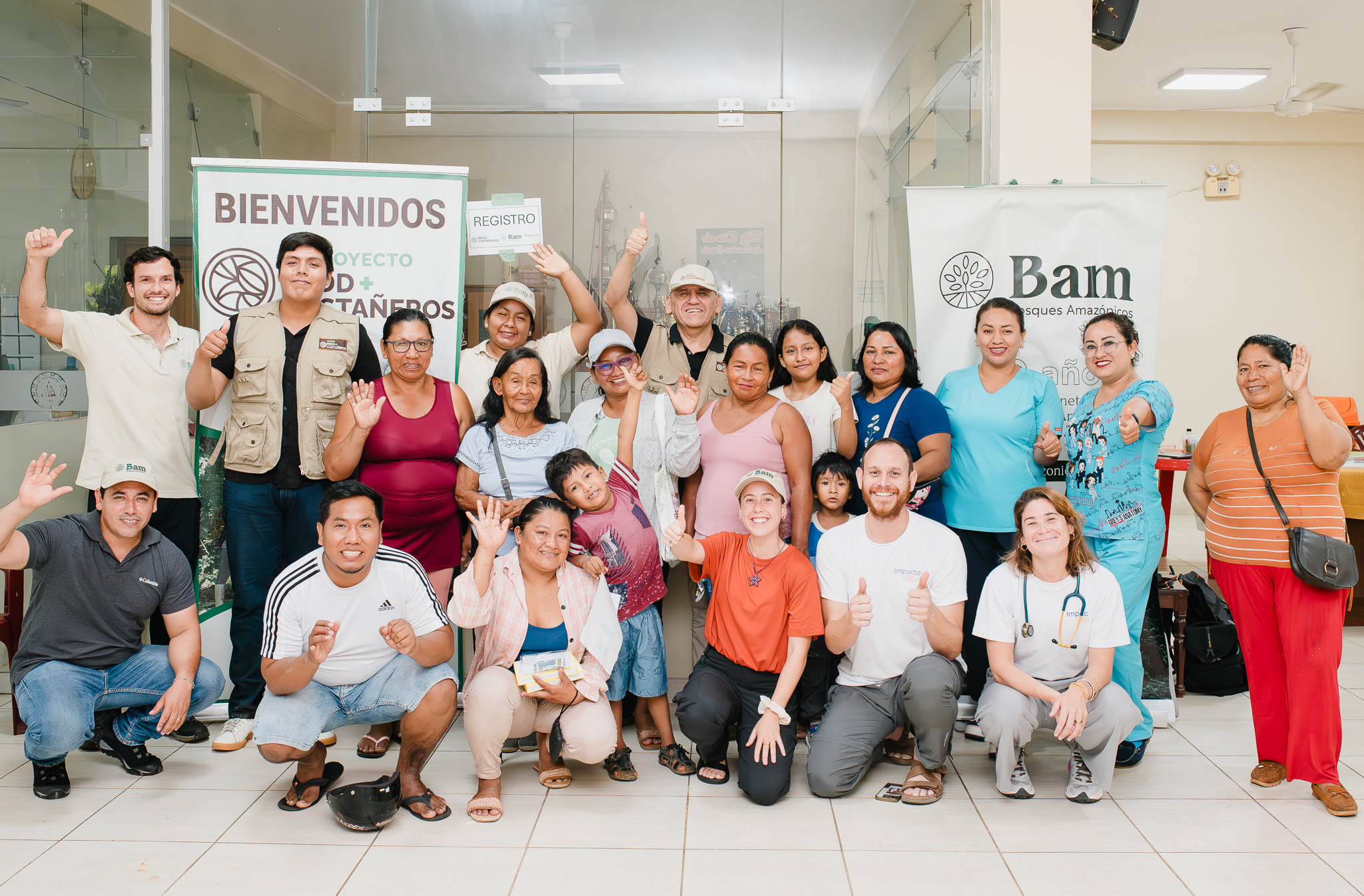
Carbon credits with REAL impact: 200 families benefited from the health campaign in REDD+ Castañeros
REDD+ Castañeros Madre de Dios is conducting a medical outreach campaign that benefits more than 200 families and demonstrates that carbon credits generate…