


Field Notes: The 2020 Quinillal Expedition. By Walter H. Wust

A slender canoe cuts through the mirror-like waters of the Manantay River delta, breaking the reflection of the semi-submerged forest. It glides smoothly among the trunks of large catahuas and renacos, while groups of jacanas and sultan hens fly off toward the floating grasslands amid intermittent squawks. The canoe is carrying a group of researchers to the Quinillal camp, located several kilometers deep within this flooded jungle. They are biologists from the Center for Ornithology and Biodiversity (CORBIDI), who have traveled to this area of Ucayali to conduct the first assessment of biological diversity in the forests conserved by the company Bosques Amazónicos BAM and protected from the constant threat of encroachment by rice farmers and land developers.


A well-preserved forest is a valuable asset anywhere in the world, but it becomes a rare luxury when you consider its proximity to the city of Pucallpa , which, with a population of 330,000, is one of the fastest-growing cities in the Peruvian Amazon.
Over the next seven days, the team—composed of ornithologists (bird specialists), herpetologists (amphibians and reptiles), mammalogists (mammals), and experts in hydrobiology (aquatic environments)—will seek to unravel the secrets of these rainforests and document the creatures that make up the complex natural structure of the forests spanning the property’s nearly 24,000 hectares.
The project is part of the Science Program launched by BAM to assess the ecological value and importance of the ecosystems located on its properties. Among its objectives are conducting an ongoing inventory of natural diversity with an emphasis on the most ecologically valuable species and communities (threatened or endangered species, species with restricted distribution, organisms new to science, and others); performing an ecological characterization of the property’s natural communities (primary and secondary forests, lowland forests, and disturbed areas), which will enable precise zoning with a view to their conservation and eventual sustainable use; and, last but not least, to restore, to the extent possible, the property’s most valuable natural environments with a view to facilitating the return of wildlife species and promoting natural processes such as pollination, the restoration of ecosystem balance, and ecotourism, among others.


Restoring ecosystems damaged by human overexploitation may be one of the most efficient and cost-effective ways to combat climate change, while helping to preserve entire populations of wild flora and fauna. “If one-third of the planet’s most degraded areas were restored and this protection were extended to areas that are still in good condition, it would be possible to store the equivalent of half the carbon generated by human-caused greenhouse gas emissions since the Industrial Revolution. These changes would prevent 70% of species extinctions,” according to research published in the journalNature.
“Restoring forests, grasslands, floodplains, wetlands, and other ecosystems—which were largely replaced by farmland—to their natural state would allow for the absorption of 465,000 million metric tons of carbon dioxide and would save most of the endangered species of mammals, amphibians, and birds.” This is according to a report prepared by 27 researchers from 12 countries under the leadership of the Institute of Environmental Science and Technology at the Autonomous University of Barcelona, Spain (ICTA-UAB).
The researchers venture into the forest before dawn. Armed with binoculars, recorders, directional microphones, Sherman traps, mist nets, and an array of laboratory equipment, they walk along the flooded trails in search of their observation and collection sites. The rain comes, falls, and passes. The creatures of the jungle show themselves only for a moment, but they reveal their presence through their songs and calls, their footprints in the mud, or their low flights among the treetops.
In just 6 days of surveying, in the middle of the rainy season, the team of specialists managed to record 223 bird species. “Considering the brief duration of the survey, this represents a very interesting level of diversity that we hope to supplement with a future survey during the dry season.” says Thomas Valqui, one of the country’s most renowned ornithologists, who also serves as president of CORBIDI and is a research associate at the Museum of Natural Sciences at the University of Louisiana.
“Given the variety of birds found here and the area’s proximity to the city of Pucallpa, we recommend exploring the possibility of using this location to develop birdwatching or bird-watching tourism,” he adds.
Peru is the country with the second-highest number of bird species in the world; however, it is also one of the countries with the least knowledge about its avifauna. The number of species correctly documented for Peru has increased by 200 species over the past 12 years. There are areas in Peru where, for various reasons, little ornithological research has been conducted. “The forests managed by BAM are located in a poorly studied area—a sort of information gap regarding Peru’s avifauna. This presents a great opportunity to conduct long-term ornithological research, assess the value of birds in the context of ecosystem services, and develop ecotourism.”
Valqui explains that “the proximity to the city of Pucallpa presents, on the one hand, a major conservation challenge, and on the other, logistical advantages that offer a great opportunity to conduct scientific research and promote the birdlife through ecotourism.”


“A total of 36 species recorded in Quinillal are listed in the CITES appendices, 34 of which are listed in Appendix II. Birds such as the jabiru (Jabiru mycteria) and the peregrine falcon (Falco peregrinus) are listed in Appendix I, which includes species facing the highest level of threat.”
“One of the most interesting species found during the assessment was the paujil (Mitu tuberosum), a bird the size of a large turkey that prefers floodplain forests, where it is now rare due to hunting pressure from humans. This sighting is noteworthy because, due to human pressure, the species has been eliminated or is very rare across much of its geographic range. Its presence indicates the good conservation status of these forests.”

For his part, Luis Alberto García Ayachi, a herpetologist and research associate at CORBIDI, states that “in just 6 days of sampling, a total of 23 species of amphibians and 19 species of reptiles were recorded. Based on the results, we estimate that there are a total of 61 species of amphibians and reptiles in the Quinillal sector. This gives the area a high level of biodiversity.”
“The specimens recorded in Quinillal account for 33.82% of all amphibian species and 18.27% of all reptile species found in the department of Ucayali. The Quinillal area is conducive to the conservation of the amphibian and reptile species found there and their inherent genetic potential,” says García Ayachi.


“This high species diversity is threatened by agricultural activities, logging or deforestation, and livestock ranching. Furthermore, MINAM (2020) reports that between 2001 and 2018, the department of Ucayali lost 384,474 ha of forest, with Coronel Portillo and Padre Abad being the provinces with the largest areas of forest loss,” and adds: “It is urgent to ensure the preservation of the forests in the Quinillal sector, and thereby the protection of the amphibian and reptile communities inhabiting these areas, given the high rate of deforestation in the province of Coronel Portillo.”
Javier Barrio Guede, a mammalogist and associate researcher at CORBIDI, estimated that there are about 25 species of mammals in the study area, “a high number for an area as close to a city as Pucallpa. With the use of bat nets, the number of mammal species recorded for the area is expected to increase substantially.”


“We found traces of animals that tend to disappear quickly from areas near Amazonian cities, such as the tapir or sachavaca, a species considered threatened and classified as ‘Vulnerable’ on both Peru’s Red List and the IUCN Red List.”
“The forests preserved by the BAM are a site of great importance for conservation, biological research, and tourism, precisely because they are so close to the city. This makes the area an attraction for natural science students and for tourists visiting Pucallpa.”
Finally, Gustavo Hiromoto Medina and María José Deza B., who were in charge of the expedition’s hydrobiology team, noted that “the Ucayali River basin is one of the four major freshwater biogeographic units in the Peruvian Amazon. Separated from the Madre de Dios , and Purús basins by the Fitzcarrald Arc, and from the Marañón basin by the Pasco Knot, this biogeographic unit covers the largest area within Peruvian territory and is one of the most species-rich. However, it is also one of the regions with the highest levels of human intervention and the greatest risks to the conservation of aquatic environments, due to the intensity of land modification (intensive agriculture), the proliferation of water resource exploitation projects, and the development of road projects.”


The importance of continuing to discover the diversity and value of wildlife in the forests of Ucayali is abundantly clear. We scientists at BAM will continue to return to the forest to unravel its secrets and, with the help of science, lay the groundwork for its conservation and sustainable use.
Walter H. Wust
Continue reading
-
 News
The planet is getting warmer. What can we do about it?
The planet is getting warmer. And the consequences are becoming increasingly hard to ignore. This summer, heat waves, droughts, and…
-
 News
The Artisans of Inin Jabe: When Preservation Also Means Creating Opportunities
At the Bosques Amazónicos (BAM), we believe that conservation goes beyond protecting forests. It also means creating opportunities for the people who live…
-
 News
REDD+ Fellows Castañeros – Education as a Priority in the Amazon
Creating Opportunities for Future Generations At Bosques Amazónicos (BAM), we believe that conserving a forest also means investing in the people who protect it.…
-
 News
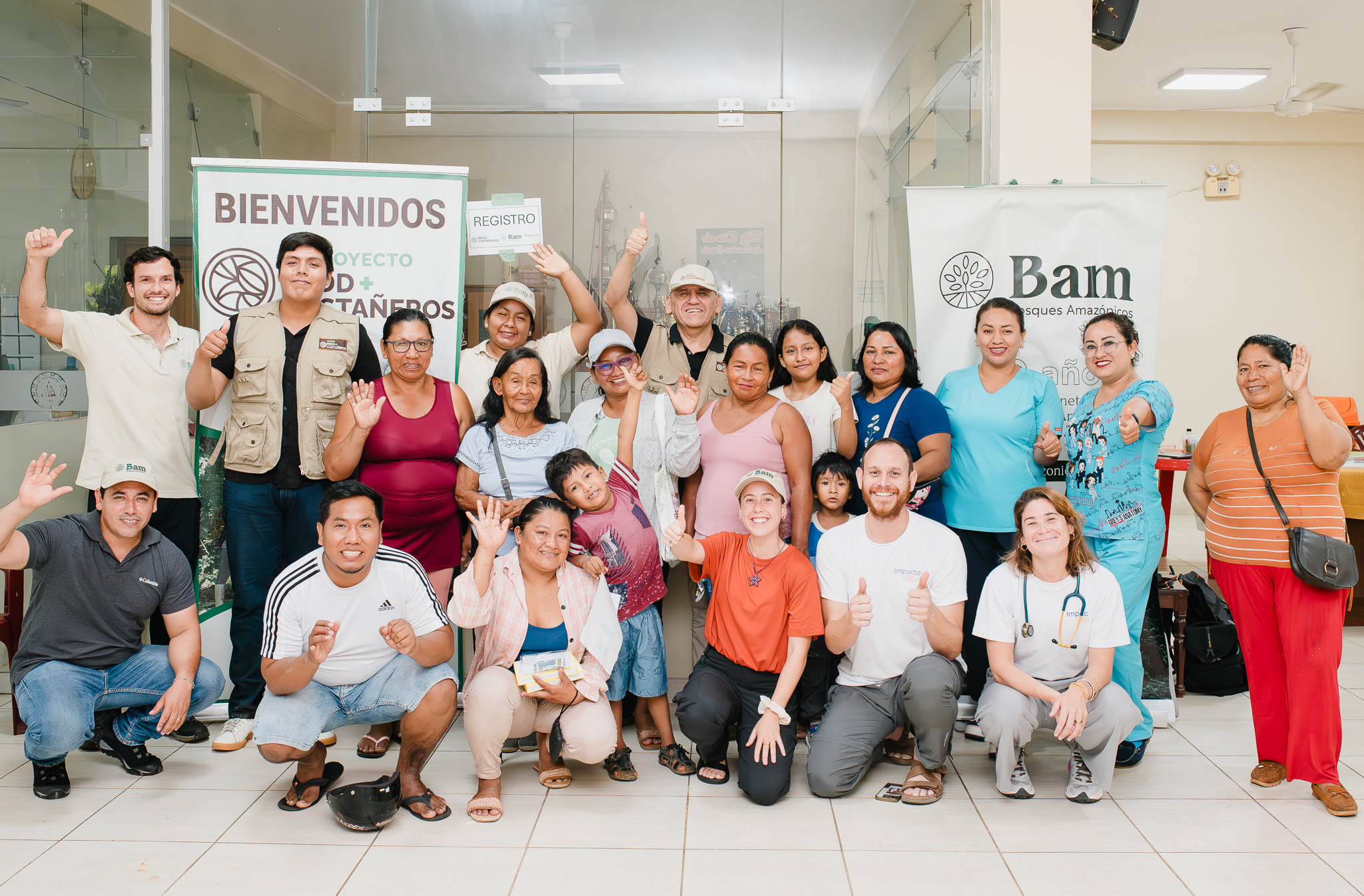
Carbon credits with REAL impact: 200 families benefited from the health campaign in REDD+ Castañeros
REDD+ Castañeros Madre de Dios is conducting a medical outreach campaign that benefits more than 200 families and demonstrates that carbon credits generate…