


Second Biodiversity Assessment in Quinillal, Ucayali

Text and photos: Walter H. Wust / BAM
–
Not even an hour has passed since we left cold, gray Lima, and the 38°C of Pucallpa hit us all at once as we stepped down the airplane stairs. The region’s humid air is a comfort to those of us who are used to visiting the Amazon, but it takes those visiting this tropical city for the first time by surprise. The air is heavy with an intense, worrying smell of smoke. We know full well why: we’re in the middle of the dry season, and the jungle sky can’t hide the gray haze caused by the thousands of hectares burned each year.

There’s no time to waste. Corbidi’s multidisciplinary team, made up of half a dozen researchers, is preparing to enter the town of Quinillal, one of the checkpoints maintained by Bosques Amazónicos BAM to ensure the conservation of this section of jungle located at the mouth of the Manantay River—perhaps the most valuable stretch of forest in the vicinity of Pucallpa.
Armed with binoculars, recorders, directional microphones, Sherman traps, mist nets, and a host of other equipment, the scientists enter the camp with high expectations. This time, they will visit the area during the dry season, which will not only make access much easier but also allow them to enter areas that remained flooded during the rainy season, when the previous assessment was conducted.
Traveling in several all-terrain trucks, the team covers in just one hour the stretch that used to take half a day to traverse with water up to their knees, on an exhausting hike that required up to four hours under the intense tropical sun. Flocks of noisy parrots swirling among the aguaje palms and the song of partridges welcome the team to the camp, which has been set up to accommodate visitors during a week of intense fieldwork.
 .

The afternoon following our arrival brought several surprises. The first could not have been more auspicious: the team of ornithologists spotted a puma high up in a tree while searching for mixed flocks of birds— a rare sighting that confirms the presence of top predators in the area. The second was as serious as it was surprising: a fire set by nearby farmers spread dangerously, reaching the very edge of the property protected by BAM. Company workers, aided by the scientists, spent hours fighting to keep the fire from spreading. They ultimately managed to prevent the flames from reaching the camp, but the scene nearby was terrifying and overwhelming.
The jungle is turning into smoke in Ucayali. The region’s great biodiversity is threatened by the growing expansion of agricultural areas, extensive livestock farming, and urban growth. A study by MINAM (2020) reports that between 2001 and 2018, the department of Ucayali lost 384,474 ha of forest, with Coronel Portillo and Padre Abad being the provinces with the greatest loss of tree cover.
The Quinillal sector, which protects Bosques Amazónicos in the department of Ucayali , features an ecosystem of low terraces, with a relatively flat, flood-prone topography and a water level during the rainy season that rises more than 1.20 m above ground level. However, with the arrival of the dry months, even the floodplain forests succumb to the onslaught of fire.
Aniceto Daza, the forestry technician in charge of establishing the permanent plot in Quinillal, says:
“This forested area is located just a few kilometers from the city of Pucallpa. For many years, access to this area has been effectively controlled, which has prevented the destruction of unique ecosystems. Due to urban expansion, many similar forested areas have been destroyed in the past. In that sense, Quinillal represents a valuable example of virtually untouched nature that is easily accessible.”

The work of botanists is vital and serves as the spearhead of the expedition, as it allows researchers to characterize the forest's composition and identify the dominant habitats and species in each location.
Daza adds: “There is an abundance of species that serve as a food source for wildlife; these include those of the genus Inga (wild pacaes), whose fruits are a favorite food of primates and arboreal animals, as well as a wide variety of birds. Similarly, Zygia and Parkia trees provide nectar that serves as food for specialized bat colonies.” Fire-resistant palms (Astrocaryum, Attalea, Euterpe) are also considered key species in terms of providing food for primates and birds, along with species from the Sapotaceae and Moraceae families. Finally, species of the genus Sapium are known as a food source for parrots, and this genus is present in significant numbers. Quinillal has all the characteristics necessary to serve as a suitable wildlife refuge.”
Carlos Reynel, director of the Herbarium at the National Agrarian University—La Molina and head of the botanical team, is very enthusiastic about the project’s potential: “The establishment of the first permanent plot or arboretum in Quinillal is of special importance, as monitoring it over time will yield useful scientific information on taxonomy, floristics, plant-animal interactions, and forest dynamics. This can lay the groundwork for establishing the site as a hub for international and multidisciplinary scientific research. To give just one example: a species within the plot is possibly new to science (Lafoensia sp., family Lythraceae) and warrants further investigation to obtain complete botanical specimens.”

I meet Thomas Valqui and Jorge Novoa in a forest clearing located one kilometer from the camp. They have come here to check a set of mist nets that their assistant, Walter Vargas, has carefully set up using poles driven into the ground and secured with stakes. “Mist nets work like fishing nets at sea; because the threads are so thin and black, the birds don’t see them and get caught when they fly through the area,” Valqui explains.
As director of Corbidi and head of the scientific team, he is responsible for the ornithological assessment in Quinillal. His extensive field experience ensures a thorough record of the birds in the area, which is supplemented by recordings and birds caught in the nets we have come to inspect.
“Surveys conducted in Quinillal recorded a total of 286 bird species across 22 orders and 52 families. This represents nearly 15% of Peru’s bird species along a route of just 12 kilometers. Of these, 63% were present during both seasons. This indicates that at least 182 species inhabit these forests year-round.”
A small, brightly colored bird has been spotted online. It is a band-tailed pipra (Pipra fasciicauda), a species that—although common—is very difficult to spot. There are about 24 species of pipras in the Peruvian rainforest. All have strikingly colorful plumage and perform elaborate courtship dances to attract females, much like the famous cock-of-the-rock.

As he walks, scanning the tree canopy, Valqui adds: “The bird community is interesting because of the site’s biogeographic location. It is important to note that Quinillal lies at the intersection of two major biogeographic regions, which increases the likelihood of finding birds from both areas in the same place. Additionally, we have also found species classified as threatened under national legislation and by the International Union for Conservation of Nature (IUCN).”
“This is an area that has been little studied in Peru, so it is of great interest for conducting more detailed studies of certain species. In that sense, it is a good place to establish long-term monitoring programs and—why not?—a biological station.” He adds: “At the same time, the biodiversity found here—and certain species in particular—are of great value for exploring opportunities in the growing birdwatching tourism industry.” Given its proximity to Pucallpa, Quinillal could be an excellent location for developing birdwatching programs—whether short or extended visits—for both domestic and international tourists.”

Another group working in Quinillal focuses on attracting insects using colored traps and butterfly nets. This group is led by Akira Wong Sato, a research associate in Corbidi’s plant ecology division. Sitting on a fallen log, he opens his backpack and pulls out a wax paper envelope neatly folded into a triangle. He carefully shows me the wings of a Morpho helenor butterfly with metallic hues. “It’s a species under high capture pressure, since its wings are used to make handicrafts. Here, however, it has turned out to be very abundant.”
During the assessment, Akira and his assistant, biologist Patricia Manrique, identified a total of 276 insect species using various capture methods. “Many of these insects perform irreplaceable functions for the ecosystem, such as pollination and pest control,” adds Wong, all the while watching a bumblebee’s erratic flight over the vegetation.

The night is the realm of herpetologists—that is, experts in the study of reptiles and amphibians. Luis Alberto García Ayachi is a research associate in Corbidi’s herpetology division. Every day, when everyone else is fast asleep in their tents, he sets out to explore the mosquito-infested trails, flashlight in hand, in search of frogs, geckos, and snakes of all kinds… a job he’s passionate about but that to others would sound like the worst kind of torture.
I take advantage of his presence to photograph some of the creatures he’s caught during his nighttime forays. I’m fascinated by a small caiman, barely 40 cm long with shiny scales, known as the “lagarto de quebrada” or “dirin dirin” (Paleosuchus trigonatus). It lives in small waterways deep within the Amazon rainforest. “It tends to be quite aggressive despite its size. Its body, with strong armor and sharp teeth, is perfectly adapted for hunting fish,” he says, as if speaking of a lifelong friend.
“The diversity found in the Quinillal sector totals 57 species, comprising 26 amphibians and 31 reptiles, which represent about one-third of the total number of species known in the department Ucayali; a very interesting figure given its proximity to the city of Pucallpa.”

“Among the new records are two species classified as threatened that should be prioritized for conservation: the caiman Paleosuchus trigonatus, classified as Near Threatened (NT) (MINAGRI 2014), and the turtle Chelonoides denticulatus, classified as Vulnerable (VU) (IUCN 2021).”
We walk alongside the areas that were burned a few hours ago, right on the border between the forests protected by BAM and the neighboring agricultural areas. García Ayachi stops and shows me the singed skin of a small lizard that didn’t manage to escape the fire. “Amphibian and reptile populations are threatened by uncontrolled burning and deforestation in the vicinity of Quinillal. That’s why conserving this area is vital for the conservation and survival of the local wildlife,” he says. And he’s absolutely right.

The night is also “the office” for mammalogists—or specialists in mammals—led by Javier Barrio Guede, a research associate at Corbidi. Equipped with various types of traps and vanilla-scented lures, they identify wildlife passageways and examine tracks and signs. They also use mist nets to capture bats (one of the most numerous groups in tropical forests).
“Based on the trends observed in the records, we estimate that there are at least 55 species of mammals in Quinillal. Of particular note are the discovery of 5 species of monkeys, 9 species of bats, and sightings of threatened species such as the giant anteater (Myrmecophaga tridactyla) and the rare yaguarundi (Puma yagouaroundi).”

Guede points to a large footprint in the fresh mud. “We have found traces of large mammal species that tend to disappear quickly from areas near Amazonian cities. One of them is the tapir, or sachavaca (Tapirus terrestris), a species considered threatened and classified as ‘Vulnerable’ on both Peru’s Red List of Species and the IUCN Red List.”
“In addition to small primate species, such as the Bolivian capuchin monkey (Saimiri bolivianus), the red-faced capuchin (Plecturocebus discolor), and the common pichico (Leonthocebus weddelli), medium-sized primate species were also recorded, such as the howler monkey (Alouatta seniculus) and the black capuchin (Sapajus apella); the latter two face intense hunting pressure, and their meat is trafficked illegally. Primates are also sought after for the illegal pet trade.”
The day is drawing to a close. The mosquitoes remind us that it’s time to head back to camp to rest and prepare the samples for the lab. We walk back, while Javier shares a final thought with us:“This area has great potential to be designated a conservation area. This will be vital for protecting the wildlife species that use these forests as a refuge.”
At BAM, we are fully committed to that goal. Currently, the forests protected by the company are in the process of being designated as the “ Campo Verde ” Private Conservation Area. The legal protection of nearly 20,000 hectares will bolster the conservation efforts that Bosques Amazónicos has been carrying out for more than a decade. A promising future lies ahead for this patch of green jungle right on the border of Pucallpa.

Text and photos: Walter H. Wust / BAM
Continue reading
-
 News
The planet is getting warmer. What can we do about it?
The planet is getting warmer. And the consequences are becoming increasingly hard to ignore. This summer, heat waves, droughts, and…
-
 News
The Artisans of Inin Jabe: When Preservation Also Means Creating Opportunities
At the Bosques Amazónicos (BAM), we believe that conservation goes beyond protecting forests. It also means creating opportunities for the people who live…
-
 News
REDD+ Fellows Castañeros – Education as a Priority in the Amazon
Creating Opportunities for Future Generations At Bosques Amazónicos (BAM), we believe that conserving a forest also means investing in the people who protect it.…
-
 News
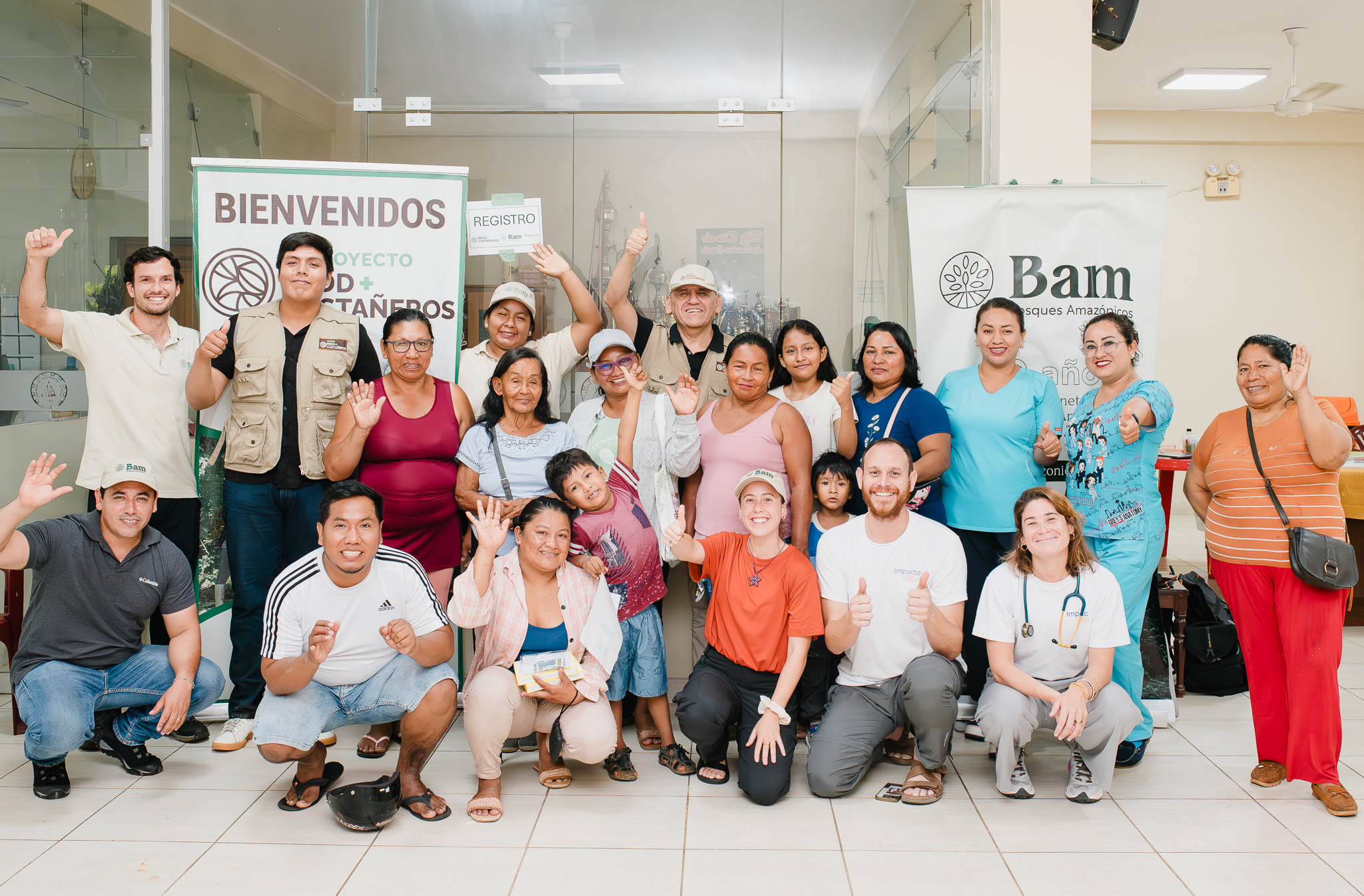
Carbon credits with REAL impact: 200 families benefited from the health campaign in REDD+ Castañeros
REDD+ Castañeros Madre de Dios is conducting a medical outreach campaign that benefits more than 200 families and demonstrates that carbon credits generate…